
How to make a Timber Cookbook Stand


DIY Handyman Toolbox is a new app that comes in either a Metric or Imperial versions.
DIY Handyman Toolbox - IMPERIAL, is a handy, easy to use application to help you work out common handyman calculations like volume (cubic yards), area (square feet) and also to convert measurements from imperial to metric, or metric to imperial.
Also included is an optional area to include the unit price of the material and DIY Handyman Toolbox will calculate the overall cost for you as well as the required amount.
FEATURES:
• Volume - Cubic yards & Price Calculator
• Area - Square feet & Price Calculator
• Conversion - Convert measurements from imperial to metric or metric to imperial.
• Very easy to use.
• Clean, professional user interface design.
DIY Handyman Toolbox is useful to the Home Handyman as well as professional trades people, as a quick and simple way for working out material amounts and total prices.
HANDY FOR CALCULATING ANYTHING THAT NEEDS TO BE ORDERED IN SQUARE FEET OR CUBIC YARDS.:
• Flooring - Timber & Carpet
• Walls - Paint, Wallpaper and Plasterboard (dry wall)
• Gardens - Mulch & Gravel
• Concrete
This application will save you a lot of time when working on your home improvements and renovations.
Click here for more info on the METRIC version.
Click here for more info on the IMPERIAL version.

The Imperial version of my handyman iPhone app' DIY Concrete is now available on the iTunes App Store.
This version has a redesigned user interface and handles all the calculations you need to work out and order concrete for your project in cubic yards or in 80LB pre-mixed bags. Click here to go directly to the iTunes App Store.
Click here to go to the DIY Concrete website.
DIY Concrete Imperial - is a handy, easy to use application to help you work out the volume and cost of concrete (cement) required for your project, in cubic meters or 80LB pre-mixed Bags.
DIY Concrete Imperial - is useful to the DIY Home Handyman as well as professional trades people, as a quick and simple way for working out concrete volume and price requirements.
This application calculates the volume you require when ordering for a large amount that will be delivered by truck, as well as a 80LB Pre-mixed Bag calculator for the smaller DIY Handyman projects.
As well as calculating the volume, you can also add the cubic meter price or bag price to give you an overall cost of the concrete order.
All you need to do is enter the Length and Width in feet and the Depth in inches. The price component is optional. Then press the "Calculate" button.
Click "Reset" to start again with clean empty fields.
Also included are a couple of DIY Concrete Tips for on-site 90 degree set-out and the ratio for a standard concrete mix.
Here is a new app that I have created for the DIY Handyman, and it is also handy for the professional trades person.
DIY Concrete is a handy calculator to help work out the volume and pricing of your concrete projects. The application will calculate cubic meters and price for the larger projects that require delivery by concrete truck, and it also calculates the qty of 20KG Pre-mixed bags required for the smaller projects. This version only calculates in metric, but the imperial section will be added soon, and will be available as a free download when available.
Here is a link to the DIY Concrete website for more info.
Also, click here to go directly to the iTunes store and download the app.
This post is a bit off topic, but hopefully it is interesting to some.
I have been spending some time learning the iPhone SDK recently, while planning to develop a DIY Handyman iPhone application, (that will include the Spirit level and calculators etc.)
However, as a start I have completed my first few apps that have been accepted into the iTunes App Store.
Being my first attempt I have kept to simple finance / productivity applications that calculate and reverse calculate sales tax, and you have a choice of 5 different versions.
Oz GST Mate - Australia, Goods and Service Tax (GST).
VAT Mate - United Kingdom, Value Added Tax (VAT).
NZ GST Mate - New Zealand, Goods and Services Tax (GST).
HST Mate - Canada, Harmonized Sales Tax (HST).
GST Mate - Goods and Servics Tax (GST) for Australia, New Zealand, Canada and Singapore.
Clicking on any of ther links above will take you to their website that has all the info and a link to the iPhone App Store to download.
I am still planning the DIY Handyman Application, so if you have any suggestions on the features you would like to see implemented please let me know.
 Dewalt is launching a new exciting product simplify the process of making long straight cuts. Gone are the days of measuring the distance between your blade and the guide and clamping a straight edge onto your material.
I haven't had a chance to use one, but this product looks very handy indeed. The product details from Dewalt are below.
Click here to go to the Dewalt site.


DeWALT LAUNCHES CORDED & CORDLESS TRACKSAWS
New Precision Saw System Allows Users to Quickly Cut Large Sheet Materials
August 2008 – DeWALT, a leading manufacturer of industrial power tools, announced the launch of its corded and cordless TrackSaws (DWS520 and DC351). The DeWALT TrackSaws provide a new option to finish carpenters, woodworkers, and contractors looking for a portable tool to make straight, splinter-free, precise cuts. Winner of a 2008 International Design Excellence Award, the TrackSaws combine the precision and cut-quality of a table saw, the capacity of a panel saw, and the portability of a circular saw.
The DC351 and DWS520 TrackSaws travel along an anti-slip aluminum track allowing users to make clean, straight and precise cuts. The zero-clearance track features anti-splinter edges indicating the exact cut location, so cut positioning is fast, intuitive, predictable, and accurate. The track’s underside has two friction strips to “grab” the material – keeping the track from moving without the need for additional clamping. The top side of the track has four low-friction glide strips, enabling the saw to smoothly travel along the track. Tracks are available in several lengths. All wear components are user-replaceable and will be available as accessories.
The DWS520 features a DeWALT-built, 1,300 watt motor, providing enough power to cut though hardwoods, and all common woodworking and construction materials. The straight plunge mechanism enables the user to make clean, straight, and splinter-free inside (plunge) cuts. A Continuous Anti-Kick-Back feature may be engaged as well – providing additional control by only allowing the saw to move in a forward direction on the track and thus preventing kickback.
The DC351 and DWS520 also have a dust management system with a universal 1¼” dust port that collects up to 90 percent of excess dust and debris. A 6-1/2” 48-tooth woodworking blade with a laser cut plate and precision ground teeth provides exceptional cut quality. Cutting depth (on the track) is 2-1/8” @ 90º, and 1-5/8” @ 45º bevel, allowing users to cut through all common materials.
The DC351 offer users the flexibility of a cordless TrackSaw option powered by DeWALT’s 28V Lithium Ion battery. The 28V TrackSaw provides users the same accuracy, capacity, and quality of cut as the corded version – and cuts more than 121’ of 5/8” plywood on a single charge.
Available in Q4 2008, the new TrackSaws are designed for cabinet makers, remodelers, finish carpenters, general contractors, furniture makers, and hardwood floor installers. When cutting sheet-goods, paneling, or doors, the new TrackSaws will make straight, splinter free cuts at nearly any angle in practically any location.
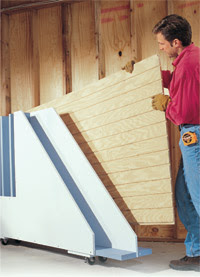
I recently built a rack in my shed to hold all the sheet material that I keep, or have left over from other projects. It was basically 2 lengths of 3x2 fixed to the wall on an angle with a couple of shorter bits on the bottom to keep the sheets raised off the ground. Nothing fancy but it does the job.
Here is a product I first read about on the Bob Villa site.
Too many times we here stories of the Home Handyman (and professional contractors) rushing to get a job done and causing themselves or others injury. But rushing can also make make your job actually take a lot longer to complete. One thing that is always drummed into your head as an apprentice is:
"Measure twice, cut once"
A simple philosophy that works on more than one level.
How many times have you been in a hurry and "measured once", and ended up having to cut twice or more?
Here is a great new product that should help prevent some of the usual DIY accidents around the home. It is called Laddersmart and it has been designed to secure your ladder to the gutter of your house to prevent accidents and falls. It should also protect your gutter from damage that can be caused by your ladder leaning up against it.


As an update on my Water Hammer post, I found some interesting info on the subject at the "One Project Closer" blog.
Here is an easy solution for the DIY handyman.


By: India Cooper
Have you hired a bricklayer and you're not sure what he'll get up to? Here's a quick guide so you know what's in store...
Bricklayers do small one-off jobs but they are also an essential part of a building team, constructing and maintaining various structures. These include internal and external walls, chimney stacks and tunnel linings on both domestic and commercial buildings. They can also build fancy stuff like arches, garden walls, barbeques and benches.
A bricklayer coming to work on your project will use a variety of tools (both hand tools and power tools such as a cement mixer) and materials (bricks, blocks, mortar, lintels) depending on what the job involves.
Your brickie can't just turn up and start building a wall. He first needs to measure out the area and make sure he understands the architect's or designer's plans. He then works from the corners building up with bricks and mortar. He may work in a team, or at least have a labourer with him to keep supplying him with materials. The trade can be quite hierarchical, with labourers handing out tools, materials and tea, junior bricklayers doing straightforward laying and the more experienced bricklayers taking care of corners and decorative brickwork.
As he builds up a wall your bricklayer will be using a spirit level and plumb-lines (string stretched horizontally as a building guide) to ensure the wall is straight. He may also use tools to cut and shape the bricks (for instance around openings for doors and windows). And he will shape and make neat the mortar in between known as "pointing".
Your bricklayer will either use a corner lead or corner pole method to build. Corner lead involves building a pyramid of bricks at each corner. Once these are complete the walls in between can be filled, often by a less experienced bricklayer. But corner leads need to be really precise so they are time consuming and expensive.
Corner poles, also known as masonry guides are the alternative. The corner poles or posts are fixed and plumb-lines stretched between them, to guide the bricklaying. A layer of mortar (a cement mix) is then laid and bricks are laid and built up, with mortar to hold them in place.
On a big project a bricklayer may need temporary platforms of even scaffolding to reach up high. And if windows and doors are being inserted into a wall then a joiner will follow close behind to put in the frames.
So what sort of person do you want your bricklayer to be? He should be able to follow plans and be methodical, careful and physically fit - there'll be a lot of heavy carrying involved. You may also need him to be a good team worker and get on with other contractors if he's working as part of a bigger project.
And what sort of qualifications is he likely to have? Most brickies learn their trade on the job but there are formal qualifications they can get if they are happy to study. Local colleges can provide courses to gain NVQ qualifications in Trowel Occupations levels 1 to 3. This involves learning the essentials such as setting up and taking down working platforms, building structures (e.g. walls) and safe loading and unloading of materials.
Beyond the basics there are areas for specialist training including bricklaying, stone fixing and craft masonry. Once fully experienced bricklayers can become supervisors or estimators and beyond that construction managers.
If you are hiring a bricklayer it's worth taking an interest in what he is doing (while allowing him to get on with the job). Not only will it put you in a position of confidence but like anyone, your bricklayer may appreciate the interest you are taking in his trade.
Author Resource:-> Expert bricklayer India Cooper explains what one should expect when hiring a bricklayer. To find out more please visit http://www.ratedpeople.com/find/bricklayer
Article From Niche Article Directory


I needed to purchase some treated pine for 2 different projects. One was for some internal framing, which I wanted to protect against termites, and the other was for a gate post which would be outside and in the ground.
Here is a great environmentally friendly building product.


Here is a fantastic book called "The Complete Blokes and Sheds - Stories from the shed". Amazon.com describes it as:
Here is a great little video showing the benefits of changing from the old style light bulbs to the more energy efficient and eco friendly CFL's. (Compact Flourescent Lightbulb).
Here is a very interesting blog highlighting different styles and designs of bookshelves, like the "Bookseat" and the"Cantilever Bookshelf" both pictured here.


